
From Lesson-Planning Chatbot to Corpus-Grounded AI
ELLA-AI has developed through a series of teacher-facing experiments exploring how artificial intelligence can support multilingual learners and the educators who teach them. Each version tested a different part of that problem—from making AI accessible to teachers, to creating a dedicated instructional interface, to grounding AI support in authentic educational language data.
ELLA-AI 2.0 — Standalone Web Prototype
2025–2026 · Experimental web application

ELLA-AI 2.0 explored how AI-assisted instructional support could move from a conversational chatbot into a dedicated teacher-facing application. The prototype introduced a more structured interface for lesson planning and tested how ELLA-AI might eventually operate independently of a general-purpose AI platform.
This version remains available as an experimental legacy prototype and documents an intermediate stage in the development of the project.
ELLA-AI 1.0 — Original Lesson-Planning Chatbot
2025 · Teacher-friendly AI lesson planning

The original ELLA-AI chatbot was designed as a low-barrier introduction to AI-assisted lesson planning. Rather than requiring teachers to master prompt engineering, ELLA guided them through familiar instructional decisions such as grade level, English proficiency, lesson duration, learning objectives, activities, assessment and student accommodations.
The original chatbot remains available for educators who want a simple way to experiment with AI-supported lesson planning before moving into more advanced AI environments.
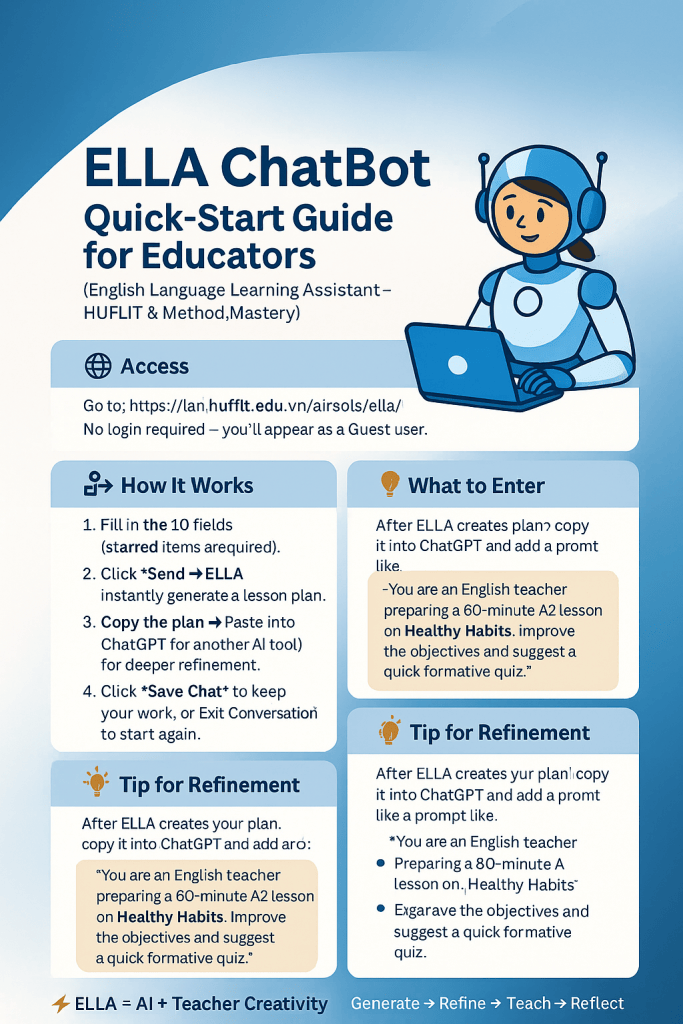
Quick-Start Guide
This guide was created to help educators begin using the original chatbot without prior experience with AI prompting.
Early Classroom Experiments
Before ELLA-AI became a corpus-grounded research project, it grew through practical experiments with generative AI, lesson planning and multilingual instruction. These early demonstrations document how the project moved from classroom experimentation toward a more systematic educational AI architecture.
What Happens When Health Ed Meets AI?
This early experiment explored the use of generative AI in health education lessons for middle-school learners in Taipei. It represents an important bridge between classroom practice and the later research question behind ELLA-AI: how can AI support instruction when it is grounded in the language, curriculum and learning demands students actually encounter?
ELLA-AI is being developed through authentic educational partnerships rather than hypothetical demonstrations.
Built on Real Classroom Evidence
Current research and pilot projects demonstrate how educational language infrastructure can be translated into classroom-ready AI systems through collaboration with teachers, universities, and multilingual learning environments.
- NYC Urban ELL Curriculum Corpus
- Hong Kong Polytechnic University
- HUFLIT, Vietnam
- New York Middle School Science teachers


Teachers — especially those who are new to the profession or returning to it — find ELLA-AI genuinely useful for planning differentiated lessons. The speed is remarkable, and the interface guides you through exactly what you need to think about. — Educator feedback, HUFLIT Pilot Program, Ho Chi Minh City
Real educational partnerships continue expanding the system through curriculum development, classroom implementation, teacher practice resources, and institutional pilot studies.
The Next Stage: ELLA-AI 3.0
From generative lesson planning to corpus-informed teacher decision support.
These experiments ultimately led to a different question:
What happens when educational AI is grounded in curated curriculum data and the language students actually encounter rather than relying on generic prompting alone?
ELLA-AI 3.0 is the current corpus-grounded research prototype being developed alongside the NYC Urban ELL Corpus and Teacher Practice Corpus.